
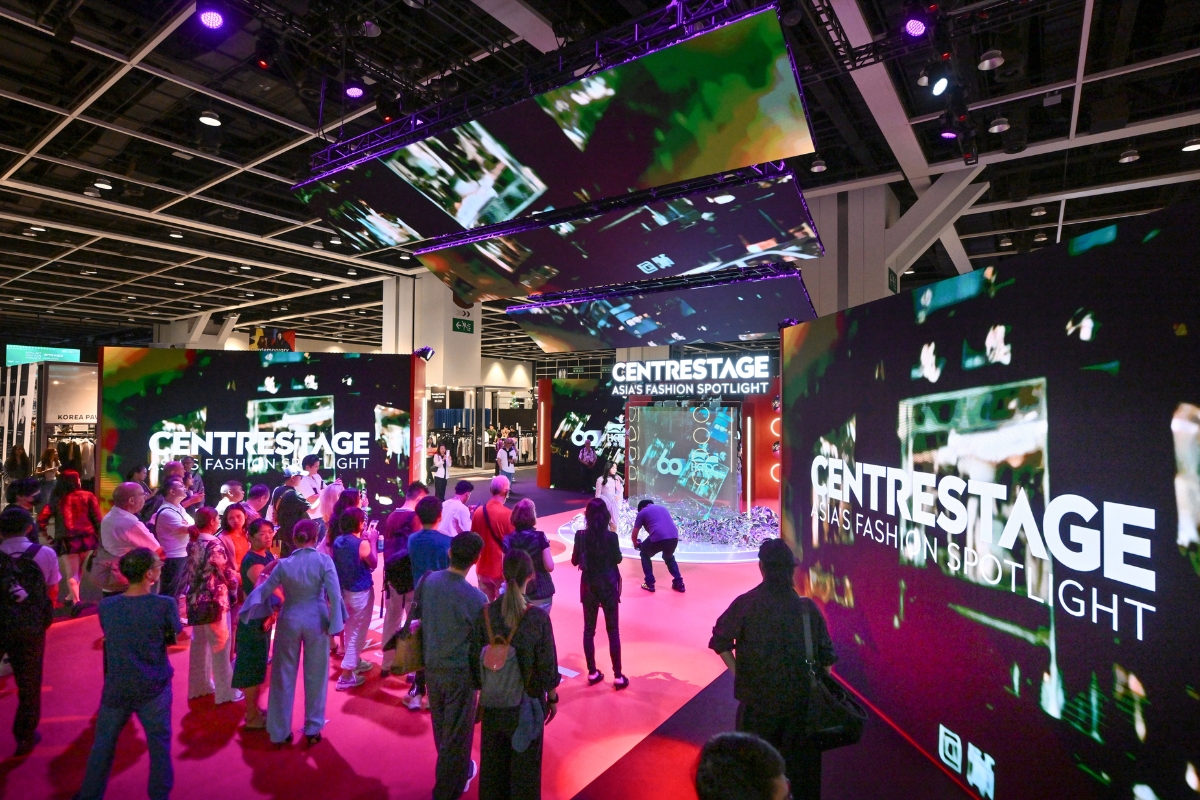
For New Zealand retailers, international opportunity does not always mean taking a local brand offshore. Sometimes it means looking in the other direction and asking what the rest of the world has that New Zealand has not discovered yet.
That was the thinking behind the Fashion Council of New Zealand taking a delegation to CENTRESTAGE 2026 in Hong Kong.
Across four days, the delegation was immersed in an international fashion marketplace where emerging labels sat alongside established names, new collections were being launched, and retailers and distributors from around the world were actively looking for their next commercial opportunity.
For New Zealand, being part of that environment creates possibilities that are difficult to generate from home.
CENTRESTAGE’s 11th edition brought together around 270 brands from 24 countries and regions, the highest number of participating brands in its history. More than 12,000 trade buyers from 93 countries and regions attended, also setting a new attendance record.
Among them were buyers from Selfridges and Dover Street Market London in the United Kingdom, 10 Corso Como in Italy and Musinsa in South Korea. The event placed a strong emphasis on sourcing and business matching, bringing together brands looking for new markets and buyers actively looking for new opportunities.
Fashion Council of New Zealand co-founder Caitlan Mitchell said that the concentration of international businesses made CENTRESTAGE particularly valuable for the New Zealand market.
"For New Zealand retailers and distributors, having this many international brands and markets in one place is a fantastic opportunity," she said.
"We are so far away from the rest of the world, so being able to walk into one room and meet businesses from across Asia, Europe and beyond is incredibly valuable. And these are not tire-kickers. Everyone is there to do business, whether that is finding a new brand, entering a new market, securing distribution or starting a wholesale relationship. You can have conversations in four days that could otherwise take months of travelling to different markets."
The commercial activity happening throughout CENTRESTAGE demonstrated how quickly those conversations could turn into something tangible.
Selfridges menswear and streetwear buyer Sophie Rose Davis-Evans met with more than 10 emerging brands during her first visit to the event. Two Hong Kong labels, peces and MURFI LAU, stood out, with wholesale partnership negotiations underway by the fair's conclusion.
Galeries Lafayette Indonesia was interested in introducing Australian brand VICETA WANG and Chinese Mainland label WANZZZ to its retail outlets, subject to commercial terms. Chengdu fashion retailer Triple Major went even further, placing three orders during the fair, including with Danish label Henrik Vibskov and Thailand’s Collector Project.
For New Zealand retailers and distributors, those examples show why being physically present in an international fashion marketplace still matters.
A trip to Hong Kong can put a business in front of hundreds of labels without requiring separate buying trips across multiple countries. It also creates the possibility of finding something before it already has established representation in New Zealand.
That could mean securing a new label for a store, introducing a product customers have not encountered locally or identifying a larger opportunity to represent and distribute a brand throughout New Zealand.
One market particularly relevant to New Zealand in 2026 was South Korea.
Korea made its debut as CENTRESTAGE’s Featured Partner, bringing a significant contingent of Korean fashion to Hong Kong. Twelve designer brands from Seoul were presented through a collaboration involving KOTRA and HISEOUL SHOWROOM, while another 10 labels from Gyeonggi Province joined through the Gyeonggi Fashion Creative Studio.
The timing pairs particularly well with New Zealand’s growing appetite for Korean culture and consumer brands. K-beauty and K-pop have already made South Korea increasingly familiar to New Zealand consumers, while fashion offers another area for retailers and distributors to explore.
At CENTRESTAGE, the Korean presence was not simply promotional. Business was being done.
Some brands had already reached deals with Hong Kong buyers to launch offline retail, while participating labels connected with department stores, chain retailers and speciality-store buyers from markets including the Chinese Mainland, France, Germany, Kazakhstan, Russia and Thailand. Seoul-based avant-garde label Asparagus also attracted buyer interest from the Chinese Mainland, Southeast Asia and Australia, with initial orders expected as it expanded further into the Asian market.
For the New Zealand delegation, having that concentration of Korean labels in one place created an opportunity to look beyond the Korean brands already familiar internationally and see what could be next.
The international field extended much further.
Austria debuted at CENTRESTAGE with seven sustainable fashion brands, while Colombia, the Faroe Islands, Malaysia, Slovakia and the United Arab Emirates were among the other markets participating for the first time.
The Australian Fashion Council also returned with a delegation. Its original programme of around 120 buyer meetings grew to 180 during the four-day fair, with participating businesses subsequently pursuing retail collaborations in Hong Kong and partnerships in Korea and Japan.
It was another indication of what CENTRESTAGE can achieve when brands and buyers from different markets are concentrated in one place.
Fashion discovery also broadened in 2026.
A new Perfume zone brought together fragrance brands from around the world, with more than 20 making their Hong Kong debut. The fair also introduced Hype², a new pavilion responding to the continued development of streetwear, where around 30 limited-edition and debut products were launched.
That expansion creates new possibilities for retailers. The next discovery does not necessarily have to be another clothing label. It could be fragrance, accessories, streetwear or a product that crosses fashion, design and lifestyle.
Cross-sector collaboration was another major theme. An HKTDC survey of more than 350 exhibitors and buyers found 73 percent agreed or strongly agreed that brand crossovers and intellectual property partnerships would become increasingly prevalent over the following year. The wider outlook was also positive, with 96 percent expecting overall sales to remain steady or grow over the next 12 to 24 months.
The runway programme offered another way to encounter what was coming next.
More than 40 events were staged during the fair, including a record of more than 30 fashion shows. KIT WAN STUDIOS opened the programme at CENTRESTAGE ELITES with more than 30 previously unseen looks, while the Fashion Hong Kong Runway Show presented Spring/Summer 2027 collections from 112 mountainyam, ANGUS TSUI, ARTY and Z I D I.
For the New Zealand delegation, however, CENTRESTAGE was ultimately about business rather than simply observing what was happening internationally.
New Zealand cannot change its geography. What the industry can do is make that distance less restrictive by placing its retailers and distributors in the markets where new relationships are being formed, and commercial decisions are being made.
CENTRESTAGE condenses an enormous international market into four days in Hong Kong. For New Zealand businesses, that means more brands to consider, more people to meet and more opportunities to find something that could have a future back home.
There does not need to be a predetermined shopping list. Part of the value is not knowing exactly what you'll find until you get there. Because somewhere among those hundreds of brands could be the next international label, product or partnership that makes perfect sense for New Zealand.